

Europe's Christian heritage cannot be washed away
09-12-2025
European Union
Joost Fidder, CNE.news
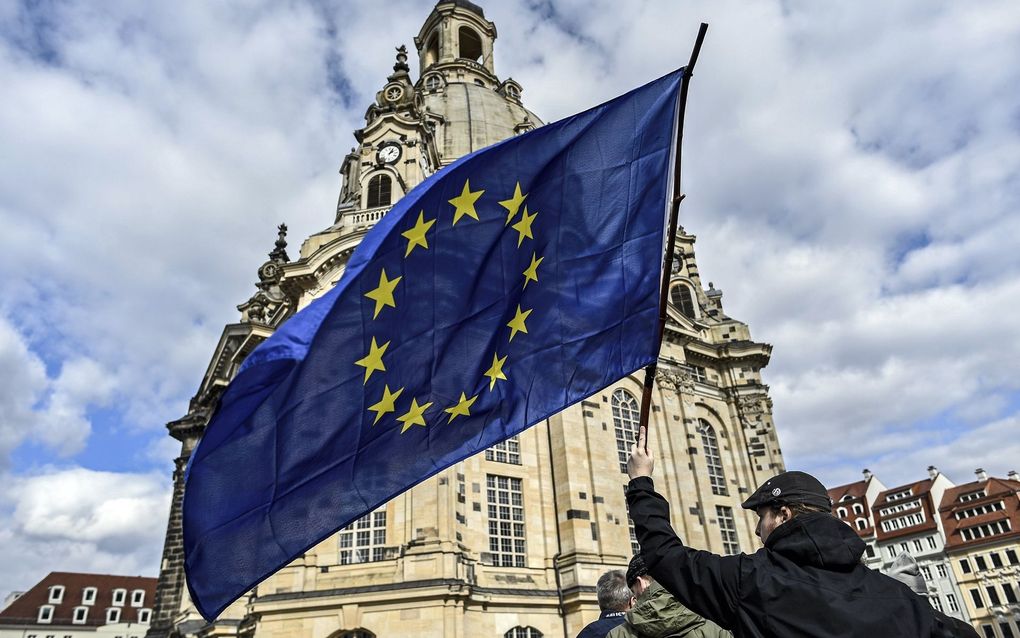
A man waves an EU flag in front of the Frauenkirche church during a pro-European Union rally in Dresden. Photo EPA, Filip Singer
European Union
The French President Chirac did not want to refer to the Christian faith in the EU treaty. Just mentioning that Europe was formed by “religion” was enough. Still, we can fill a whole book about how the Christian faith formed the continent and its culture.
We can be clear: without Christianity, Europe would have been very different from how it looks now. Before, Christianity arrived on the continent, most people served many other gods. Polytheism and the worship of emperors were the common practices in the Roman empire.
What changed? A small group of Jesus's disciples and other Christians changed a whole society through the preaching of the Word of God. In effect, Christianity turned the whole world upside down and particularly Europe where Christianity had its greatest influence through the ages.
In Christian Faith and the making of Europe, missiology professor Evert van de Poll explains the role of Christianity in the first scientific endeavours, the creation of hospitals, the founding of the European Union and the concept of human rights, among other things.
By this sudden change from polytheism to Christian monotheism, humans now are seen as those created in the “image of God”. This means that all our neighbours have intrinsic value and that we are all equal in relationship to God.
Heritage of Christian Europe
In practice, a manifestation of neighbourly care was the first establishment (or hospital) for receiving the sick built by the Christian “Basil the Great” (330-379). The word hospital comes from hospitality. So, it was not only a place for the sick, but also a place where the poor and the traveller received housing and medical care, as Evert van de Poll shows in his book.
The necessity of thinking about Europe and its heritage is of utmost importance.
Those hospitals would not have been there without the Christian faith. Throughout the Bible, God teaches his people that they are to care for the poor, the stranger, the fatherless, and the widow. Throughout the Middle Ages, this system of care was further expanded by mostly Benedictine monasteries, of which there were about 37,000.
What to think about science and religion? Religious fanatics should be excluded in that realm, right? Well, more than 75 per cent of the Nobel Prize winners between 1900 and 2000 were either from a Christian or Jewish background. Francis Bacon, who is seen as the father of the scientific method, did science for the ‘Glory of God’.
The necessity of thinking about Europe and its heritage is of utmost importance. Throughout the book, the author challenges several conceptions of Europe. Contrary to thinking about the positive effects of Christianity, there is this tendency to ‘whitewash’ Europe and present it as a product of the Enlightenment instead of Christianity.
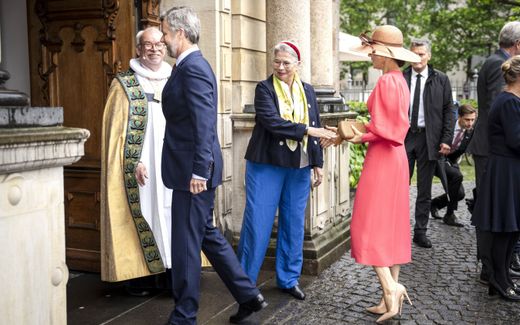
An example of this whitewashing would be the occasion in which President Chirac refused to mention the Christian heritage as a part of the declaration of human rights in the Treaty of Lisbon (2007). Besides, Evert van de Poll fights against the idea that religion only has resulted in wars, slavery and oppression from the Pope, particularly during the “dark Middle Ages”.
Formation of Europe
Christianity has spread throughout Europe through evangelism and politically particularly since the time of Constantine. The Germans were originally Germanic and those from Ireland were Celts. The Dutch followed pre-dominantly a combination of Celtic and Germanic paganism. Although, the idea of Europe itself became more popularised only during the Frankish Kingdom, as opposed to the concept of being Arab.
Furthermore, traditionally there has been a dividing line of a Catholic and Orthodox Europe which is a result of the split of the Roman and Byzantine Empire. Therefore, Europe has a variety of church religious backgrounds with different theological concepts, as the author explains.
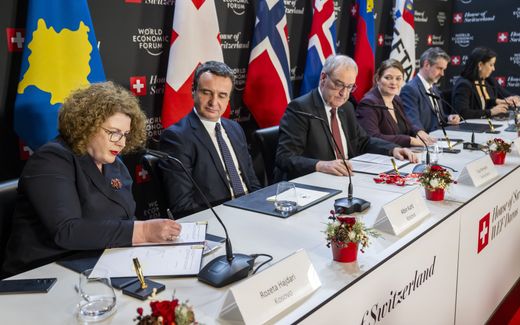
The European Union, and its economic and spiritual background, has been established by thinkers and Catholic Christians such as Konrad Adenauer, Robert Schuman and Alcide De Gasperi, as Evert van de Poll explains in his book. As well, Winston Churchill, a former prime minister of UK.
Winston Churchill envisioned a united Europe and saw Christianity as a common denominator. In the aftermath of Nazi Germany and the formation of a Western bloc, he wrote: “I am not attracted to a Western bloc as a final solution. The ideal should be Europe. The Western Bloc as an instalment of Europe would be an important step, but the case should be put on the broadest line of Europe and Christendom as a whole”. Churchill might only have had the Christian culture in his mind, since he himself was quite an open agnostic.
The central problem to the formation of Europe was that two parties Germany and France, historically were not allies, but rather twin brothers with a history of war. Originally, both were part of the Frankish Empire of Charlemagne. However, due to the cooperation of the men mentioned above –and particularly Schuman– this brotherly relationship was repaired, as Evert van de Poll puts it. Initially, talks were held in Caux, Switzerland, which brought political leaders, trade unionists, an American evangelist and those Catholics visionaries together to think about a ‘united’ Europe.
Struggles and wars can lead to development of society and concepts of human rights and dignity.
Schuman’s Catholic worldview motivated him to strive for a unity of Europe in which human rights were respected: “Christianity is a doctrine that intends to define the moral obligation in all areas of life, at least in general principles… in order to protect the greatest interest of the human person; his liberty, his dignity, and his development”, he said.
In 1950, the Schuman declaration came into effect. As a result, Europe (including Germany and France) now cooperated also in the economic field, particularly in the sector of Coal and Steel. The year 1950, therefore, is commonly seen as the beginning of the European Union.
New things learned
What does this book bring us? One can learn more about the relationship between Christianity and the practical care for our neighbour. The ancient and the modern world, polytheism and Darwinism, lack concepts of human dignity and taking responsibility for others.
Another learning point is that struggles and wars can lead to development of society and concepts of human rights and dignity. Some attribute the developments of human rights and freedoms purely to this mechanical idea of societal improvements, from feudal lords to nation states.

However, it was a group of Christians that during wars and religious oppression, stood up for religious freedom and the separation of Church and State. So, critique and adjustment came from within, mostly from Baptist and other dissent movements during the Protestant and Catholic Wars. Think of people such as Thomas Helwys, Richard Overton and Roger Williams. Tertullian, an Early Church Father wrote in 197: “Let one man worship God, another Jupiter.”
Many also blame Christianity for keeping the slave trade alive. However, it was the Christian, and politician, William Wilberforce who fought for human dignity and the abolishment of the same. In addition, the well-known pastor and hymn writer John Newton, although not mentioned in the book, supported William Wilberforce in his fight against slave trade. Newton, who was a slave trader himself, radically turned around when he converted to Christianity.
In some way, the book could also be named The making of Europe and the Christian faith, rather than Christian Faith and the making of Europe. In some parts of the book, the author describes the great heritage of the Roman Law and Greek-centred education. Throughout the history, the church, has kept alive both the thinking of Greek thinkers such as Aristotle and Plato. Unfortunately, this has not led only to benefit, but also to very divisive thoughts and concepts to Christianity.
Enlightenment
Evert van de Poll explains that humanists are usually those who are convinced of the truth of Christianity as opposed to Enlightenment thinkers, who have drifted away from Christianity in putting the mind on a pedestal above the creator.
However, even humanists might have drifted away. Erasmus rejected the concept of predestination, and, therefore, gave favour to the human mind in the matter of salvation. As an Arminian, he favoured the position of our own free will in receiving God’s grace, while his opponent in some respect, Martin Luther was convinced that our own will is in bondage and that receiving grace is a sovereign act of God. Our own views on matters such as Arminianism and Calvinism can colour our perceptions of history in the same way.
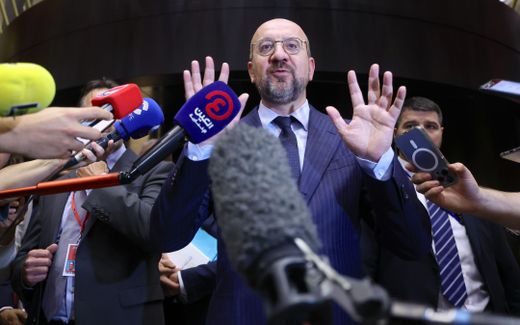
In the book, the author puts Erasmus as the Christian humanist and therefore contrary to the Enlightenment thinkers. However, others may come to conclude that his more Arminian tendency is the spring of the Enlightenment. John Locke, one of the prominent figures in the Enlightenment and Francis Bacon, mentioned earlier, are both contemporaries of Erasmus and were raised in a Calvinistic household. Just like Erasmus, they gave up their Calvinistic soteriology in the matter of salvation.
Reflection
The history and state of Europe is important enough to reflect and meditate upon. We have put our minds above the Creator, and as a whole continent we “want to make a name for ourselves”.
In the midst, of becoming more enlightened, we, as Europeans, have aborted many babies, celebrated immorality, have fallen in endless entertainment and so have become slaves of our digital accessory.
People are unhappy, and many complain about the lack of brotherly love. Rather than seeking a life in Christ, many are depressed with increasing numbers of suicide. These problems could possibly increase in an age in which transhumanism is propagated. We should cry out with Isaiah and call out the woes of our generation.
Thinking about our past, may help but in the end, it is only God that makes deserts fruitful fields, and fruitful fields a forrest. Let us, as Christians, understand the beauty of the Bible along with our Christian heritage to proclaim the Gospel to our neighbour.
Christian Faith and the Making of Europe: Yesterday and Today, by Evert Van de Poll; published by VTR Verlag für Theologie; 2021; 420 pages; price 25 Euros.*



Related Articles