


Why an Albanian mayor’s detention deserves justice among Christians

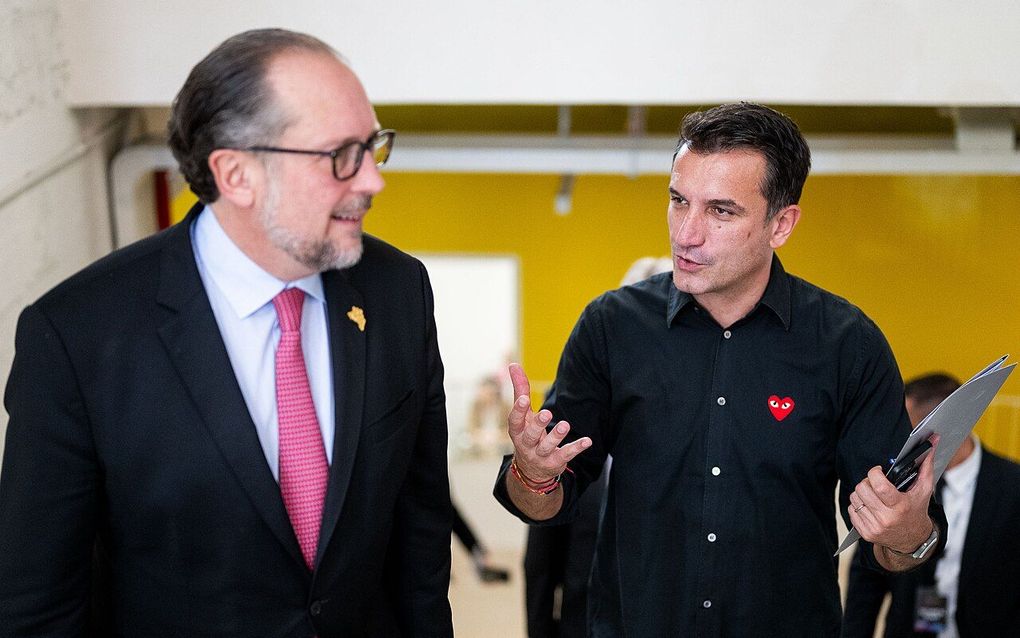
Erion Veliaj (right) speaks to Austria's foreign minister, Alexander Schallenberg (left) during an international summit in Tirana, Albania. Photo Wikimedia Commons
Southern Europe
As elected mayor of Himara and member of Albania’s Greek Christian community, the 2023 imprisonment of Fredi Beleri drew international attention.
He received support ranging from Greek political and religious figures European Parliament Members. He was later elected as Greek representative to Brussels while still in prison.
The case highlighted wider questions about minority rights that included Greek-Albanian relations and Albania’s justice system, as well as concerns over the country’s high use of pre-trial detention. It also highlighted how politicians and faith leaders across Europe can contribute to justice.
Yet another high-profile detainee, Tirana Mayor Erion Veliaj, raises a different set of concerns. Veliaj has served as Mayor of Tirana since 2015. Despite spending 1.5 years in pre-trial detention, he has become one of the longest-serving and most senior figures in the ruling Socialist Party.
Cut off
Unlike Beleri's case, Veliaj’s imprisonment does not centre on ethnicity or religion. Although Veliaj is a practicing Evangelical Christian, there is no indication that his faith was a factor in his detention. Rather, the case is significant because of his political prominence and the broader implications of his prosecution.
That said, as Veliaj is cut off from the outside world and limited to visitors from his immediate family and lawyer, one may only assume that his faith serves as a source of strength.
During a Christmas speech with Christian faith leaders in Tirana, he said: “I believe that God tests us in each of these experiences. It tests us in war, it tests us in pandemics, it tests us in earthquakes, it tests us where our limits are, how willing we are to behave as brotherhood and not as customers.”
Until his detention in February 2025, Veliaj was a close political ally of Prime Minister Edi Rama. Under his leadership, Tirana transitioned into a green and people-centred urban success story.
He championed child-friendly development projects that reshaped the city's landscape with new playgrounds, public parks, and vibrant pedestrian spaces, earning plaudits from Gil Peñalosa, the founder of 8 80 Cities, an NGO devoted to improving urban life. Mayor Veliaj was also one of few public figures belonging to the Christian faith.
As mayor of Tirana, the city also transformed from a religious perspective. Once a remnant of communist capital city, he laid the ground for the reconstruction and construction of places of worship. Such a feat earned the appreciation of Anastas Janullatos, the Archbishop of Albanian Orthodox Church.
Many Albanian watchers saw Veliaj as the leading candidate to succeed Rama as head of the Socialist Party. Veliaj’s arrest and continued pre-trial detention, which was initially prompted by an anonymous complaint, have significantly altered those prospects.
Such events have also made the case all the more deserving of scrutiny by European stakeholders committed to the rule of law, including Christian leaders and members of the European Parliament.
An important case
Veliaj’s case is of great importance because it shows the limits of the electoral mandate face to face national authorities willing to deploy coercive legal mechanisms against a prominent political figure. In the wake of Veliaj’s arrest, the Tirana Municipal Council moved to use his pre-trial detention as grounds for removing him from elected office. It took the intervention of Albania's Constitutional Court to prevent his dismissal.
The Constitutional Court’s intervention indeed proved pivotal. Most recently, in late June, the Constitutional Court of Albania issued a second landmark ruling in favour of Mayor Veliaj, annulling a lower court decision and remanding his case for renewed review.
The Constitutional Court held that the lower court failed to conduct a constitutionally required, meaningful review of his continued pre-trial detention. The Constitutional Court had more to say. The lower court had also failed to evaluate its necessity and proportionality, consider less restrictive alternatives, or weigh the constitutional consequences of preventing a democratically elected mayor from exercising his voter-conferred mandate.
The Constitutional Court's reasoning closely mirrors broader European constitutional standards on local democracy. The Venice Commission of the Council of Europe, Europe's leading advisory body on constitutional affairs, warned in its October 2025 report that local officials outside the electoral process undermines democracy.
As Albania continues its path toward European Union accession, the integrity of its judicial processes demands closer examination. Cases like those of Beleri and Veliaj are not isolated incidents but indicators that Albania's judiciary still has important reforms ahead, such as a new Criminal Procedure Code.
European stakeholders, such as members of the European Parliament and faith-based leaders, should encourage these reforms and help ensure that Albania's judicial system remains consistent with European rule-of-law standards.
A role to play
Christian leaders also have an important role to play – not because Mayor Veliaj shares their faith, but because the integrity of justice is itself a Christian concern. A legal system that routinely relies on prolonged pre-trial detention without sufficient justification deserves the attention of those committed to defending human dignity and the rule of law.
Just as Beleri's detention galvanised advocacy because of the minority rights and justice issues it raised, Veliaj's case should likewise prompt principled Christian engagement. And this can be accomplished through a commitment to due process, the presumption of innocence, judicial independence and the equal application of justice, regardless of political affiliation.