

Review: This ‘trans’ story questions the reality of gender identification

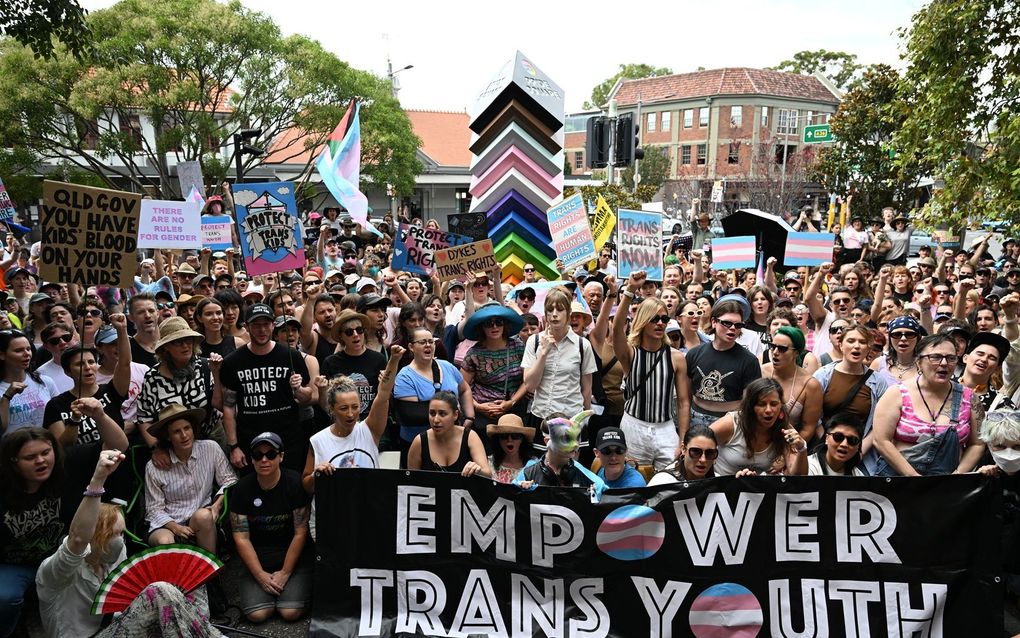
Protesters gather during a rally for young people who identify as transgender. Photo EPA, Dean Lewins
Opinion
Do you feel uncomfortable with your body? Do you sometimes feel out of place? Or are you different from others? Then you might be transgender! Sophie Griebel recognised herself in these questions (like almost all other teenagers can) and got pulled into the world of transgenderism.
At the age of 18 or 19, she suffered a lot. She had suicidal thoughts, depression and anxiety disorders. Added to that, she was never a stereotypical female, she said in an earlier interview. Changing her gender seemed the ultimate solution to leave all of that suffering behind. But she would have never guessed that her gender reassignment only led her to more suffering. Recently, she published a book about her journey and about the way back: TransAgenda: Transgender and the cult of the lost children. As a warning.
This article is part 2 of a diptych on adolescents who identify as transgender. Part 1 can be read here.
Sophie's life started off in 1995 as an unwanted baby in an unstable family in Czechia that moved around a lot, and ended up in Germany. Add to that a parental divorce and a stepfather who abused her physically and sexually, and readers have a little idea of how horrible her childhood was.
After moving out, Sophie found it still very difficult to belong. Even though she had hoped to find belonging in the working world, it estranged her even further from the world around her. Most people seemed to be driven by performance, while she herself was much more interested in the meaning of life.
And thus, her search for belonging, for who she was, continued endlessly. “I stumbled through darkness and got lost in illusions”, she writes in her book, looking back, “and believed that what my heart so desperately longed for could be found in some sort of box – one I just needed to fit into”.
Distress
Until Sophie found a place that promised warmth, safety and belonging for all those who felt out of place, as if it were made just for her. After all, did she not feel wrong in her body, like she never truly belonged, and did she not suffer from severe psychological distress and experience her gender as a burden?
For her, it made perfect sense that this community would offer her the solution to her problems:
“And all at once, everything seemed to make sense:
That's why I never felt like I belonged.
That's why I always felt out of place.
That's why I carried so much shame,
So much rejection,
So much loneliness.”
Transgenerational trauma
And so it seemed to be. Even when the first injection brought a lot of health problems and when she underwent surgery for her mastectomy. “After each testosterone shot, I felt like I could rip trees from the ground", she recalls in her book. “No one could hurt me anymore. And that conviction drowned out any trace of doubt.”
“I realised that my body was not to blame for my negative experiences”
But in the end, the inner world cannot be changed through surgical procedures. And eventually, the high wore off “when I realised that barely anything had actually changed”, Sophie writes.
However, it was not until she heard about the rape of her brother that she realised that her gender was never the problem, nor the cause for the pain in her past. “I realised that it wasn't because of my gender that traumatic things had happened to me”, she later on says in an interview. “Then, my intense journey through the transgenerational traumas began. I realised that my body was not to blame for my negative experiences. And so, I was able to find more of myself.”
As a result of her story, Griebel is very critical of the current medical practice in many Western countries when it comes to transgenderism. “Today's logic concludes: If something doesn't fit, it must be the gender.” People who are questioning their identity are encouraged in their search and led to believe that they will only be okay if they change their bodies.
According to Griebel, the transgender treatments are one big experiment to make people controllable. “The increasing control over behaviour, emotions, and personality – through biochemical manipulation via hormones, medications, and possible gene editing – could ultimately become part of a transhumanist system that robs humans of their natural dignity.”
Many women become men, because they are trying to erase an image marked by guilt, shame and sin for centuries
And in the end, more and more new treatments will have to be invented to cover up the consequences of the medical experiments, she says. “If that doesn't enforce the idea that transitioning is, at its core, an experiment, I don't know what does.”
Image
In her book, Sophie Griebel delves more into the causes behind the transgender identification of many young people, who suddenly declare that they are transgender.
One of the links she sees is between trans identification, religious upbringing and gender roles. The church, she writes, promotes the image of the sinful woman. Women are expected to endure abuse, assault and rape, and they are guilty for it too, because they are the sin. They are the temptress who leads men astray. And men never bear responsibility, because they are seen as powerless.
Many women become men, because they are trying to erase an image marked by guilt, shame and sin for centuries, Griebel concludes. They want to replace this image with something new, with masculinity which is associated with innocence.
However, even though it is well possible that several transgender youngsters struggle with this, Griebel's statements in this might be expressed a bit too strongly. Other experts, like psychologist Stella O’Malley who is also specialised in gender, mention that trans identification can happen in any family, whether they are religious, atheist, agnost, progressive or conservative. No one seems to be immune to this. Therefore, although the strong reinforcement of gender roles in the church may play a role for some, it might not be one of the main causes for gender reassignment among youngsters.
New identity
Another reason Sophie Griebel explores is the concept of transgenerational trauma. Children who say they are transgender reflect a form of disconnection, she states. Especially traumatic events make a child vulnerable to inner conflicts and emotions they believe must be fought, she argues. If a child feels powerless and overwhelmed by internal chaos, a split begins to form, from the self and from emotions, “later perhaps from the body – and finally, from reality”. In this state, creating a new identity seems a logical step for these youngsters, Griebel says.
The real reasons for the dissociative state in which many of these transgender youngsters are can often be found in family dynamics, Griebel continues. If the family in which a child grows up is unstable, the child risks developing feelings of guilt, the sense of “not being right”, Griebel writes. And that is a breeding ground for transgender feelings.
Therefore, it is crucial that families do not seek the way of medical transition, but restore the problems and traumas that are buried in their houses, she argues. Only then, connections with the inner self and other people can be restored. “The answer is [...] an inner path – one that leads through recognition, feeling and remembering toward the healing.”
And sometimes, true healing starts with parents, Sophie Griebel writes. After all, she is convinced that children reflect their father, mother, or even societal problems. Unconsciously, they absorb negative emotions in the family or other dynamics that create emotional wounds in their life. “Children [...] are the echo of a repressed cry from the past. That's why it's worth looking back – because it's the past that frees the future.” Healing cannot take place until the root causes are identified and restored.
About the book
In about 300 pages, Sophie Ben James Griebel managed to set out her own experiences with the transgender process and her observations of transgender clients in her practice as psychological worker. Her book contains short sentences and paragraphs, that sometimes almost feel poetical.
That Griebel went through gender reassignment herself, strengthens her story, but may also weaken some of the claims she makes. On the one hand, she knows what she is talking about when she describes the complexity of the feelings and emotions that accompany those who struggle with transgenderism. On the other hand, she runs the risk of generalisation in applying her own experiences to too many others. At the same time, Griebel also draws from her experiences as a psychological worker, which means that she knows more stories to confirm her findings.
For Christian readers, however, the book contains some estranging passages. For example, when the author posits the statement that Jesus did not die for the sins of the world, but that He was killed because He reminded people of their own greatness. She also says that prayer is dangerous because it outsources responsibility and gives away our power.
For Christians, the brokenness that transgender people experience has an extra dimension. Brokenness can never completely be solved through human attempts only. As a consequence of sin, the only way out of this brokenness is through redemption through Jesus Christ and the certain hope that this life is not the end goal.
TransAgenda: Transgender and the cult of the lost children, Sophie Ben James Griebel, Tredition Gmbh.



Related Articles