


This is how Silent Night was born

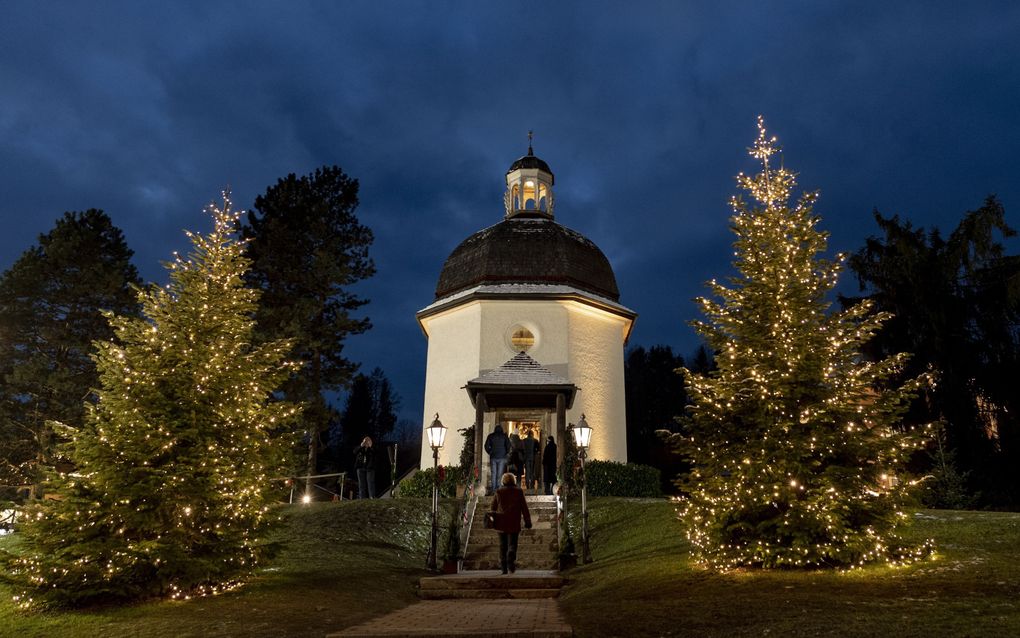
The Silent Night Chapel is located in Oberndorf, Austria and is home to the famous Christmas carol, Silent Night (Stille Nacht, heilige Nacht). Photo EPA, Christian Bruna
Christian Life
Music can transform an unknown village into a world famous place. Read here how “Silent Night” was born.
“The hills are alive with the Sound of Music”. The younger generation may not recognise these words from the famous theme song of The Sound of Music (1965). This film undoubtedly gave the beautiful Austrian city of Salzburg a worldwide fame. Yet there is a little village twenty kilometres north from Salzburg named Oberndorf bei Salzburg, which rose to international fame a century earlier.
And just like Salzburg, the fame of Oberndorf is due to music. But this time we are talking about a Christian hymn. It was indeed in St. Nicholas church of Oberndorf that Stille Nacht, or Silent Night was first sung in 1818. Don't search for the church if you happen to visit the village. Sadly, it doesn't exist anymore today, as it was destroyed by regular floods in the early 20th century.
However, you will still be able to find traces of the hymn there. There is a small octagonal chapel right on the site of the St. Nicholas church, which bears the name Stille-Nacht-Kapelle (Silent Night Chapel).
Inside the chapel, there are two stained-glass windows depicting the creators of Silent Night as well as their hometowns: the writer Joseph Mohr and Oberndorf and next to him, the composer Franz Gruber and the village of Arnsdorf. So, let’s find out who these men were.
Executioner
Josephus Franciscus Mohr, simply known as Joseph Mohr, was born on the 11th of December 1792 in Salzburg, just a few streets from the house where Wolfgang Amadeus Mozart had died only a year before.
Sadly, Joseph was born out of wedlock, and thus never knew his father. Because of this, his mother, Anna Schoiberin, had to find a godfather for her son. The only person who accepted was a man named Joseph Wohlmuth. A curious detail about him was that he was in fact Salzburg's last executioner.
Thanks to Johann Nepomuk Hiernle, the choirmaster of the cathedral, Joseph Mohr received a Christian education and became a member of the choir. This was the beginning of his lifelong dedication to the church.

At the age of sixteen, Mohr joined the seminary of Kremsmünster Abbey in Upper Austria. Later on, he returned to Salzburg to train for priesthood at the city's lyceum. At the time, a special request for permission had to be sent directly to the pope if someone born out of wedlock wanted to become priest. Thankfully, the permission was granted and Mohr was ordained priest in 1815.
Friend
The second man on the stained-glass windows is Franz Gruber. He was born in Hochburg-Ach, approximately twenty-five kilometres North from Oberndorf, in 1787. As a boy, he worked with his father as a weaver.
However, to his father’s initial dismay, his great passion was music, which he pursued secretly in the organ loft of the local church with the help of a parishioner. Later on, he became a music teacher at Arnsdorf, just a few kilometres away from Oberndorf, where he also got married. It was during these years that Franz Gruber became a friend of Joseph Mohr.
The Hymn
So, what led both men to write one of the most famous Christmas hymns of all times?
It all started a few hours before the midnight mass of Christmas 1818, when Joseph Mohr made a shocking discovery: the organ of his church was not working. This was a major setback as music formed a vital part of Christmas celebrations, just as it is today.
After a few last minute rehearsals, Gruber performed Stille Nacht with the choir during Christmas mass right as it is today.
Mohr could only pray for a miracle. Suddenly, he was reminded of a poem about the nativity that he had written some time before. After rummaging in his documents, Joseph Mohr finally found it, dashed to Gruber’s house and asked: “Would you be able to compose a melody for these lyrics?”
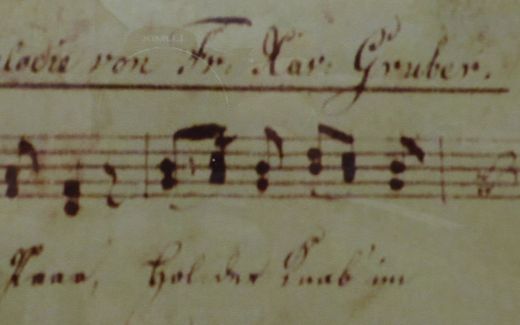
Time was short, yet Franz Gruber succeeded in providing the words with a suitable melody to be played with a guitar. And so, after a few last minute rehearsals, Gruber performed Stille Nacht with the choir during Christmas mass right as it is today.
Providence
After Christmas, a repairman from a nearby valley came to fix the organ. When he asked Franz Gruber if he could test it, the musician spontaneously played Stille Nacht. The repairman was so moved by the carol that he asked if he could take the music sheet back to his parish.
Soon, Stille Nacht spread like wildfire in the German-speaking lands, without Gruber and Mohr knowing anything about it. A few years later, Stille Nacht even reached the Protestant King of Prussia, Friedrich-Wilhelm IV, during a performance at the imperial church of Berlin. The king was so moved by the carol that he ordered it to be played in all the parishes of his empire.
However, when he asked who was the author of the carol, no name could be given to him. The king thus ordered an investigation to be made. Less than a year later, the investigators contacted St. Peter's monastery in Salzburg. This was the monastery where Franz Gruber's son was in fact a choirboy. And naturally, he was able to unveil the mystery. This is how Franz Gruber and Joseph Mohr were discovered.
The fame of the carol continued to grow even after their death. Today, it is sung in over a hundred and twenty languages all around the world.
Similarly to Joseph Mohr who couldn’t use his broken organ for the Christmas midnight mass, another Joseph couldn’t find a suitable place for his pregnant wife in Bethlehem eighteen centuries earlier. Finally, just as God, gave Mohr a solution that would eventually bless the whole world, the same Divine Providence also led Joseph and Mary to a barn, where she would give birth to the Son of God, the Saviour and King Jesus Christ.



Related Articles