

The famous Christmas star was developed by a child

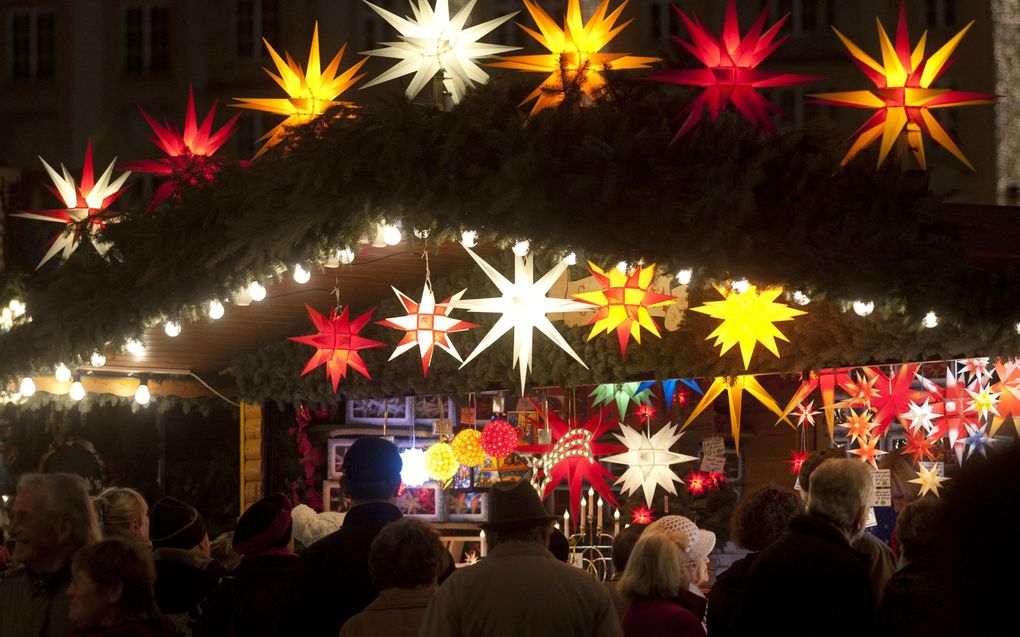
Herrnhuter stars illuminate Dresden, Germany's Striezelmarkt during the Christmas season. Photo AFP, Robert Michael
Christian Life
People with a Protestant background, or living in a historically Protestant nation, will be familiar with the Moravian Christmas stars. Traditionally, these 26-point stars appeared in churches, public squares or even private houses around Christmas. They were meant to represent the star of Bethlehem, which appeared at the birth of Jesus.
People with a Protestant background, or living in a historically Protestant nation, will be familiar with the Moravian Christmas stars. Traditionally, these 26-point stars appeared in churches, public squares or even private houses around Christmas. They were meant to represent the star of Bethlehem, which appeared at the birth of Jesus.
One place where the star is surely found today is at the traditional Weihnachtsmarkt (Christmas market) on Zinzendorfplatz of Niesky, a small town in eastern Germany. The square itself is surrounded by two church buildings standing side by side: the Evangelical Lutheran church and the church of the Moravian Brethren.
Who were the Moravians?
But before we explore the origins of the Moravian star, a few words must be said about the Moravians themselves. These people were Protestants from modern-day Czech Republic who had fled their homeland in the 18th century, a time when the Roman Catholic church had reconquered the land.
The Reformation had taken deep roots in the area then known as Moravia. That was not only thanks to the sixteenth-century Reformation that started with Martin Luther in Germany, but also a hundred years earlier, thanks to the famous martyr Jan Hus (c. 1369-1415).
In the 1720s, a group of Moravians found refuge on the estates owned by the wealthy German count Nikolaus von Zinzendorf (1700-1760). The Moravians had renamed their new settlement ‘Herrnhut’, or “the Lord’s watch,” because of a non-stop prayer watch that had started there in 1727, which would last for over a hundred years.
The prayer watch began to give rise to one of the most powerful missionary movements in history, sending people to the four corners of the world. However, some of them did not take it that far. In 1742, fifteen years after the start of the prayer watch, a group of Moravians arrived on the land of a manor owned by Siegmund August von Gersdorf (1702-1777). Like von Zinzendorf, he opened his lands for the Moravians to settle.
The Moravians chose to name their new town ‘Niesky’, which meant “low”. There were two reasons behind this. Firstly, this was a rather flat country compared to the Bohemian mountains. And secondly, the name recalled their state of humility and lowliness before God.
After a few decades, Niesky had developed into a fine centre of business and craft, thanks to what the famous German sociologist Max Weber later called the Protestant work ethic, which animated the community.
But what does Niesky have to tell us about the Christmas Moravian star?
Origins of the Christmas star
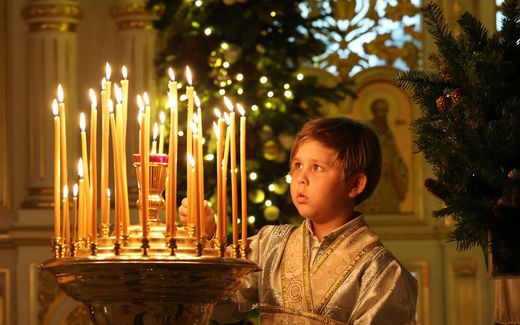
Niesky is the place where the earliest traces of the Moravian Christmas star are found. An entry in a diary written by a boarding school pupil mentioned a star made of coloured paper that had 110 points, and that was illuminated with a lamp. As many other Moravian children of the time, this child lived in a boarding school because his parents were sent abroad for missions.
Although the earliest record of a Christmas star dates from the 1820s, Moravian children used to make stars at Christmas at school, which symbolised the Biblical records of the Magi that visited Bethlehem after the birth of Jesus. And as many children missed their parents – especially at Christmas - these stars became a source of comfort for them.
By then, Niesky had a well-developed network of business and craft. And so, it did not take long before the star began to be commercialised. It was, in particular, a local businessman named Pieter Hendrik Verbeek who allowed the Christmas star to become famous worldwide.
Until then, stars were usually made out of paper, which made it hard to transport them. Therefore, Verbeek developed a new model made of more stable materials. He then began selling and shipping the stars from his shop in Herrnhut. Still today, more than a hundred years later, the stars continue to be fabricated and handmade at the Herrnhuter Sterne company.
But let’s return to the child from whom we have the earliest traces of the Christmas star. It is believed that the idea of the star was born in the mathematics classes at the city’s Moravian school, where he attended. The mathematics teacher may have used such a star to illustrate geometry lessons. But it didn’t take long for the star to get out of the maths classes. Soon, it began to teach the deeper truth of Christmas.
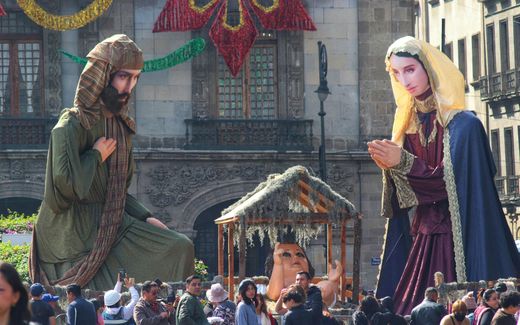
The star taught indeed that two thousand years ago, a real star appeared in the Judaean sky, announcing the birth of the Messiah. Today, as the modern Western world seems to turn away from the true meaning of Christmas, the Moravian star continues to remind millions of Christians that the King of kings came to live a life among men in this world.



Related Articles