

Is the Spanish youth returning to religion?

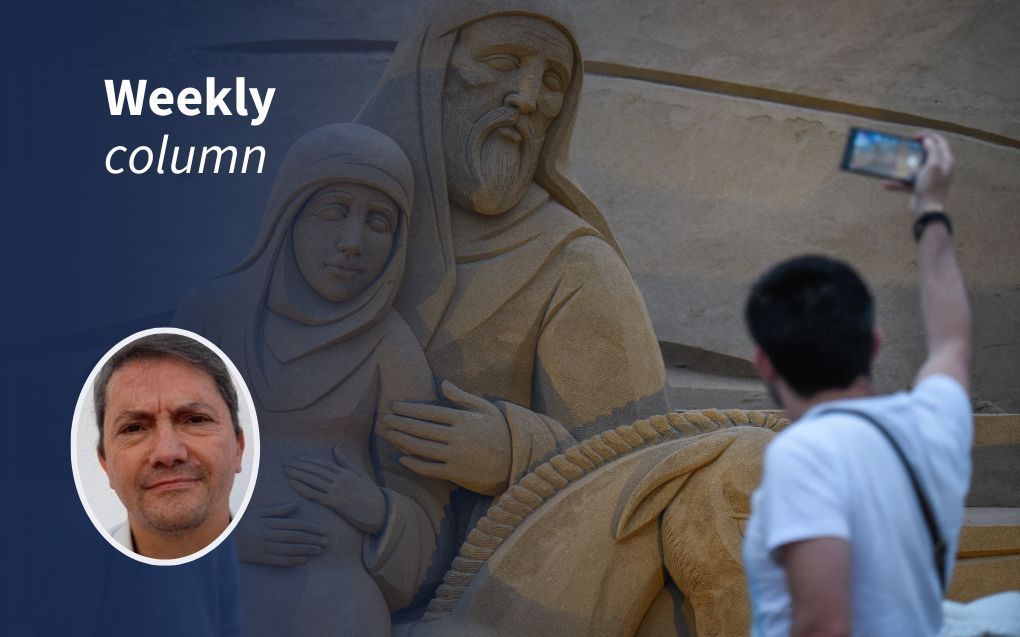
Spaniards are religious by nature. Photo AFP, Desiree Martin
Christian Life
Some Christians see a “quiet revival” in Europe. But Spaniards are “religious by nature”, Jorge Ruiz Ortiz says. They think in the categories of Augustine and Aquinas. But that does not make this a revival.
At the end of last October, there were two cultural events. With barely a week between them, there was the release of the video Berghain by the singer Rosalía, and the premiere of the film Los domingos (“Sundays”), directed by Alauda Ruiz de Azúa.
Both the lyrics and the video of Rosalía’s song contain explicit religious references. As for the film, it tells the story of a 17-year-old girl who wishes to enter a cloistered convent against the wishes of some members of her family. In the narrative, the only characters portrayed negatively are those who oppose the underage girl’s entry into the convent. Religion and religious life are presented from a positive perspective.
The temporal coincidence of these two cultural events has been interpreted by many as a “return of young people to religion,” something that numerous media outlets are already presenting as a fait accompli.
At the same time, this has set off alarm bells for others, who have been quick to respond from their comfortable seats in the opinion columns of the country’s leading newspapers with a message along the lines of: “Relax, God is not going to rise again in society.” For them, it is clear and self-evident that God is dead. But no matter how much they reject Him, they still carry the concept of God imprinted on their conscience, which is, according to Anselm of Canterbury, the proof of God’s existence in itself. But paradoxically, the great effort and sheer voluntarism they display in trying to preserve the systemic atheism of culture at the slightest hint of religion in the media reveals its very fragility.
What, then, should we think about these two cultural productions? Are they truly signs of a return of young people to religion? To begin with, we should not exaggerate the religious content of Rosalía’s song. Without entering the question of whether the singer is sincere or not, the religious expressions in the song remain superficial. Some may feel moved by hearing words such as “divine intervention,” “to save us,” or even “Christ” sung aloud.
But personally, I find it deeply off-putting to hear all this mixed with concepts proper to Islam, sung in Arabic, and even blended with outright coarse expressions in English. For this reason, I have listened to it only once –twice at most– and no more. If there were a genuine conversion, the singer would have to seriously reconsider whether to continue her career as a global music figure, as many other artists have done after converting to a different faith. Some have even done so after conversions to Islam. There is no need to mention names.
As for the film Los domingos, this is, in truth, a case with greater conceptual substance. The director does not profess to be a Christian. Yet, she has made a film that is not only extremely respectful of the Christian faith –particularly Roman Catholicism– but that in fact promotes it. How is this possible? The answer is obvious: the producers, those who invest the money in the film. Films are made with substantial funding. This is not a Marxist theory, but one of the fundamental laws of cinema.
This, then, puts us on the trail of what truly lies behind the film: major economic groups capable of financing it. And why would they do so? Because they believe they will make money, or at least not lose it.
Put differently, the very existence of both the film and the song suggests that, sociologically speaking, there is not only no rejection of religion today, but rather a genuine interest. These productions of “popular culture” are attempting, at the very least, to take advantage of this interest, or at most to channel it. For if there is an underlying substratum of interest within society, it is more than foreseeable that it will continue to develop in the future.
Respectful
I have been saying for years –and have even written it in more than one article– that the younger generation is tired of the official atheism imposed over recent decades. The youth are searching for the spiritual; they are far more respectful toward religion than their parents; it is enough to walk down the street to see many young people wearing crosses on chains or leaving church on Sunday afternoons. These are realities that are already present and that will only increase.
In fact, the message of the film Los domingos was not aimed at young people, as if encouraging them toward monastic life. Its actual recipients are their parents –my generation, still adept to the old atheist regime– to whom it effectively says: “Look, young people are going to return to religion, and you won’t be able to stop it. You would do well to accept it, lest you end up utterly alone in old age.” A message, perhaps subliminal, but clearly present.
I believe that all of this reflects a cultural trend present throughout Europe, insofar as I have been able to observe it. However, I would venture to say that it will be especially pronounced in Spain in the years to come. I am no prophet (nor the son of a prophet), as you know. But it is enough to know the people well and to understand the situation in which we find ourselves.
This is the situation I have tried to convey, article after article, over these past years in which I have written for this publication. I hope they have helped brothers and sisters across Europe to understand Spain’s spiritual condition better and why it is as it is.
## Religious by nature However, I have spoken little about how we Spaniards relate to religion ourselves. Let me conclude this article with a brief reflection on that point. I will express it in a thought-provoking way: We, the Spaniards, are religious by nature. Or, more formally, we possess deep religious and cultural structures – so deep that they do not simply disappear after a few decades of atheism imposed by cultural and political elites.
Religion is a profound imprint within us. Intuitive, perhaps immediate. So well – are we not, then, a people inclined toward mysticism?
Spaniards think in the mental categories of Augustine and Thomas Aquinas, even when they are not religious. Those of us who convert to the Evangelical faith also think religiously in the categories of Luther, Calvin, and the revival preachers. It is, without doubt, a curious mixture.
When encountering a Spanish Evangelical believer, one must always bear in mind that he is a converted Roman Catholic. The Spanish Protestant who seeks to live out his faith consistently will have the constant sensation of standing on no man’s land, never entirely fitting in with anyone – with some, for being Protestant, and with others, for being Spanish. But that, in any case, would be a topic for another article.
May you have a very blessed Christmas season.



Related Articles