


How real is the “Quiet Revival” in Europe?
12-12-2025
Christian Life
Leonardo De Chirico
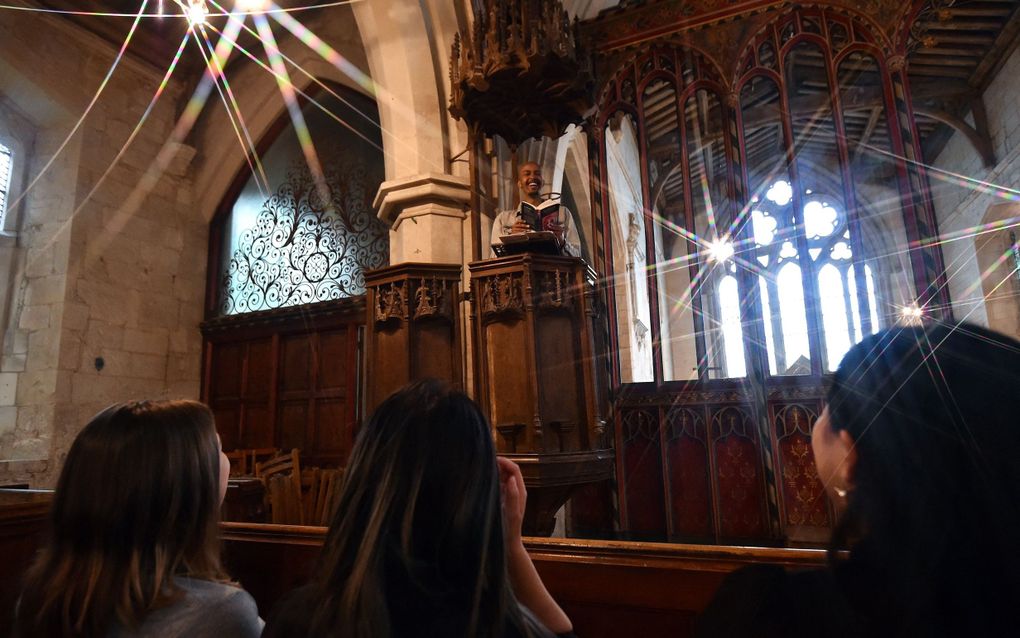
Three young people in a British church. Photo AFP, Glyn Kirk
Christian Life
There have been several rumours of increased interest in faith among Gen Z. How much of this is real? Leonardo De Chirico explores the phenomenon.
The revival is here; it is there. There is no doubt that evangelicals are highly sensitive to the word “revival”. They know that their identity, in addition to being biblical and historical, is also Protestant and revivalist. For them, revival is not only a time in the past, but also an expectation for the present. They pray for revival, they await revival. Let's say that there is also a certain fascination, sometimes naive and romantic, with revival.
People who had not previously attended services began to show up, displaying a certain attraction to certain religious practices.
In recent years, there has been quite a stir surrounding the ‘Asbury Revival’ (2023) that took place at the American university of the same name when a prayer meeting lasted for several weeks, involving thousands of students who were apparently touched and involved in their spiritual lives. Was it a revival? Many doubt it. The fact is that it seems to be all over.

Gen Z
For several months now, there has been talk of a “quiet revival”: a phenomenon that started in Britain and has since spread here and there, especially in Anglo-Saxon countries. It all started with a survey by the British Bible Society, which recorded an increase in attendance at religious services by Gen Z young people in recent months and years.
After the murder of Charlie Kirk, something similar was also recorded in the United States: people who had not previously attended services began to show up, displaying a certain attraction to certain religious practices.
Sales of copies of the Bible have also skyrocketed. Outside the Anglo-American world, in secular France, the Catholic Church has seen an increase in the number of adults wanting to be baptised. There does not appear to be a similar phenomenon in Italy.
Spirituality
It is often difficult to understand phenomena as they unfold, relying solely on surveys or impressions gathered here and there. That being said, there are at least two pieces of data that seem to demand attention.
Since one cannot live with destructive nihilism, young people are moving towards institutions that speak of and offer strong, transcendent “values”.
The first is that the ‘quiet revival’ not only affects the evangelical world, but the entire spectrum of Christian churches and denominations. It appears that in Britain and the US, Evangelical churches, as well as Catholic and Orthodox churches, are experiencing a surge in interest among young people. This means that it is not necessarily biblical faith that attracts them, but a search for a vaguely Christian spirituality that can lead to participation in Catholic sacraments, Eastern liturgies or a personal encounter with Jesus Christ.
It seems that the “void” felt by Gen Z, which motivates them to move towards religious agencies, is determined by the nihilistic excesses of secularised culture, which questions the pillars of personal identity (sexual, personal, social) by proposing a disturbing liquid alternative. Since one cannot live with destructive nihilism, young people are moving towards institutions that speak of and offer strong, transcendent “values”. Although important, the search for values is not yet considered an awakening from an evangelical perspective.
Genuine revival moments
The second point to bear in mind is that the “quiet revival” seems to be part of a process of religious re-enchantment open to all forms of spirituality, including pagan and anti-Christian ones. At a recent conference in Blackpool, the English evangelical theologian Dan Strange noted that this year's Halloween celebrations in Britain were the most popular and disturbing ever.

Young people are attracted to spirituality that impresses them rather than biblical faith. On the other hand, at the same FIEC (Fellowship of Independent Evangelical Churches) conference, many churches reported a slight but across-the-board increase in Sunday service attendance by “new” people. It is uncertain whether they will return, nor is it certain that they will convert. They came once.
When discussing revival, one must always approach the topic with caution and an open mind. Evangelical theology, from Jonathan Edwards to George Whitefield, from Richard Lovelace to Tim Keller, has some tools for examining phenomena and asking questions. Not everything that is passed off as revival is necessarily so: as Edwards taught, there are “signs and characteristics” that the Spirit imprints on genuine revival movements, in the midst of phenomena that have similar features but are something else.
This article was translated by CNE.news and published in the newsletter of Loci Communes on November 13, 2025



Related Articles