


Call for moratorium one step closer toward international surrogacy ban

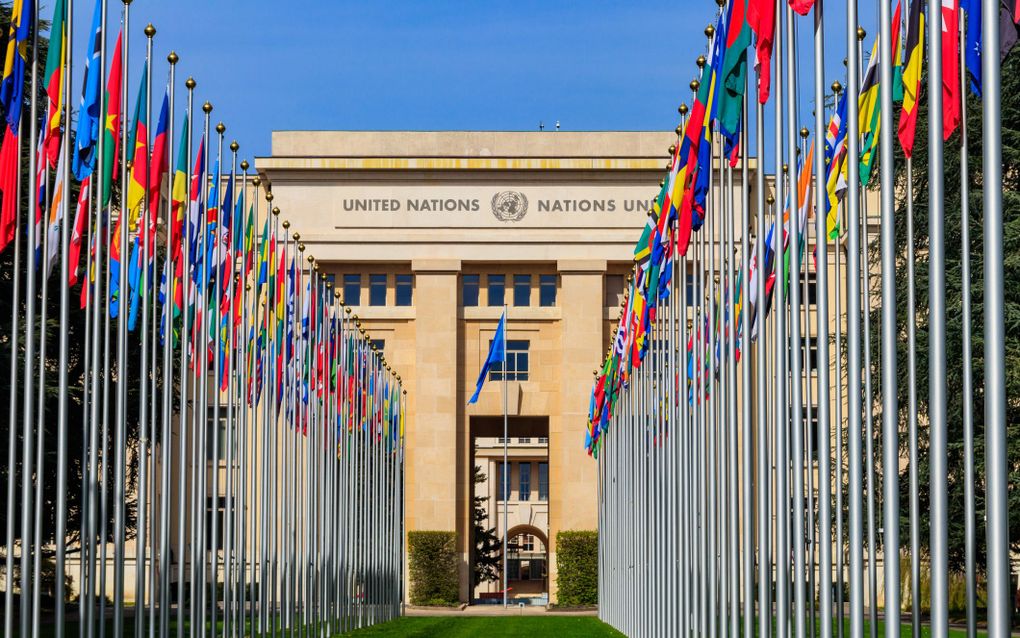
Rows of UN member state flags wave in front of the Palace of the United Nations in Geneva, Switzerland. The proposed declaration on an international moratorium was presented within the 62nd Regular Session of the UN Human Rights Council. Photo iStock, OlyaSolodenko
European Union
An end to surrogacy may be on the horizon after several states have called for an international moratorium.
Led by Italy, Chile, Cameroon, and the Holy See, the declaration calls for an international moratorium or a temporary cessation of surrogacy.
This initiative is a stepping stone towards an internationally legally binding instrument that would prohibit the harmful practice, ADF (Alliance Defending Freedom) International reports. The calls come after a key UN report exposed the industry’s harms to the international community last year.
Bettina Roska, who is ADF International’s United Nations Legal Officer, says that the declaration remains a significant step towards drafting a legally binding instrument on prohibiting surrogacy. She as well as ADF International and other actors have been working behind the scenes to inform and mobilise leaders in taking concrete steps to permanently shut down the multibillion-dollar industry.
ADF International and other key actors are currently in talks with leaders from different countries in the hopes of gathering more international support. Cooperation from doctors, lawyers, and the industry’s victims has been of critical importance. Roska says that specific entities can also have influence.
“The Holy See has a lot of potential in encouraging other states to get more committed,” she says.
Giorgio Mazzoli, Director of UN Advocacy at ADF International, says in The European Conservative that the declaration is significant because it brings states together around the “urgent need for coordinated action". He also emphasised that the motion cannot be considered only “a moral claim” but is now in accordance with international human rights law.
The proposed agreement was unveiled at an event within the 62nd Regular Session of the UN Human Rights Council. Italy, Chile, Cameroon, and the Holy See co-hosted the event, along with ADF as a moderator.
The call came after Reem Alsalem, the UN Special Rapporteur on violence against women and girls, presented a report that highlighted the numerous risks for violence involving surrogate mothers. Alsalem also agreed to support the initiative.
“The states that are joining the declaration today recognise that surrogacy raises… fundamental concerns relating to human dignity [and] the commodification of women and children. They recognise that these concerns are not only limited to commercial arrangements but also that fragmented national approaches will facilitate the growth of a global cross-border market that transfers harm onto women and children in more vulnerable jurisdictions…" This declaration shows that policy action is possible,” she explains in the ADF International press release.
The statement additionally highlights the industry’s “commodifying” human life, female reproduction, and leaving children separated from the women who carried and gave birth to them.
While more international authorities are becoming aware of surrogacy’s destructive practices, the UN’s support did not come overnight.
In 2019, the UN’s Special Rapporteur on the sale, sexual exploitation and sexual abuse of children released a report on the industries behind surrogacy and their dangerous practices. However, she concluded in the report that certain industries within surrogacy could work if there were specific regulations in place.
Roska says that ADF International and other international leaders disagreed with the conclusions in the report. “No matter how much you regulate it, the practice remains inherently harmful to women and children and their human rights,” she says.
After much international pressure to address the matter, the Special Rapporteur on violence against women and girls highlighted the need for input regarding all forms of surrogacy and their associated harms. Then in 2025, the Special Rapporteur concluded from the input’s findings that all forms were dangerous and called for a complete international prohibition.
Although Roska says that significant progress has been made in support for a moratorium, much work has yet to be done in getting more countries to join.
Giorgio Mazzoli adds in The European Conservative that the first step involves a “non-binding political declaration”. As more states join, national governments can use the text to reform their laws, close loopholes, and expand on diplomatic cooperation. It is only when “a sufficient coalition exists" that negotiations on a binding treaty or convention could take place, he says.
And when a legally binding agreement does come into focus, Bettina Roska says that can take time. Such an action not only requires political will but also certain due politics to take place, such as navigating challenges outside of surrogacy.
Yet, as ADF International continues to advocate for countries to join the declaration, she is hopeful that the industry’s abolition will happen sooner rather than later.