

Mary, who was she really?
18-12-2025
Christian Life
Elina Placentino, CNE.news
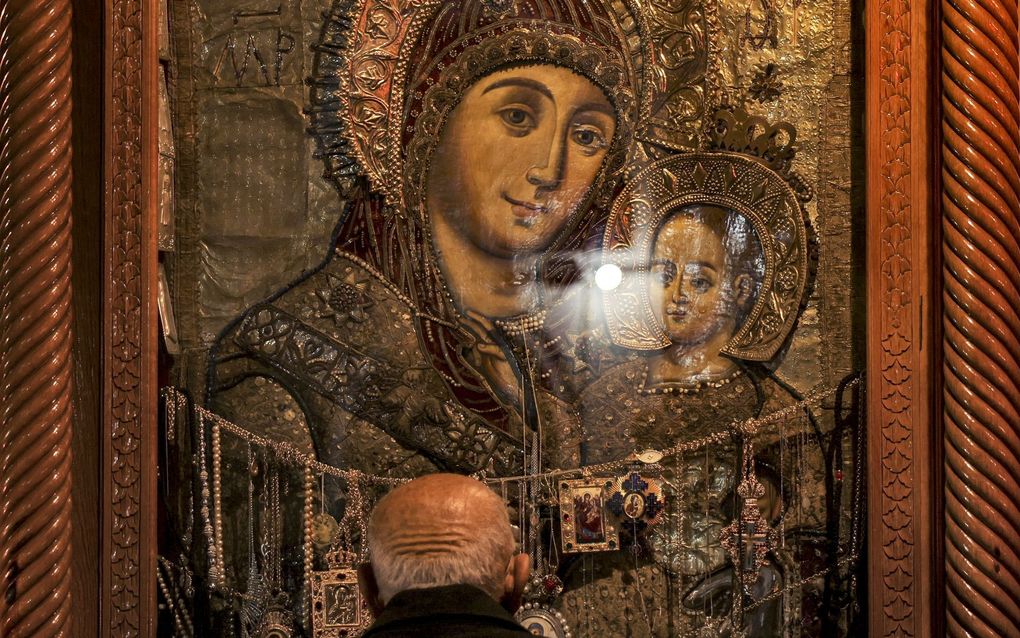
A depiction of the Virgin Mary with the Christ Child is on display near the entrance of the Church of the Nativity in Bethlehem. AFP, Hazem Bader
Christian Life
Mary, the mother of Jesus, is a central figure in the history of Christmas. But who was she?
Mary is a woman who evokes a multitude of thoughts and feelings. For some, she is the blessed mother of God. For others, she is the awkward teenager who faced an incredibly challenging task. Others, still, see her as a revolutionary figure, a champion for the poor and downtrodden. But who was Mary really?
Whatever one’s personal impressions of Mary, there are some facts that we do have about her. She lived in Judea during the time it was under Roman rule, and was possibly born around the year 16 BC. She was a young Jewish girl from the town of Nazareth, a virgin engaged to be married to a carpenter named Joseph.
And as for her character, she was a young woman full of faith who believed that whatever God had said to her would be accomplished. The Bible does not tell us everything we would like to know, but we do have an inspiring song from her in the first chapter of Luke. Perhaps it is one of the best keys to understanding her character.
Humble estate
Although we do not have Mary’s original soundtrack, the lyrics of the Magnificat in the first chapter of Luke resound loud and clear. Mary begins her song by magnifying God. And the glory of God creates a striking contrast with Mary’s words about herself. She calls herself God’s servant and particularly mentions her “humble estate”. Then she concludes that God’s work in her life will cause her to be called blessed.
Perhaps unsurprisingly, the Magnificat has, at times, been usurped for political purposes.
After that, Mary moves from the personal to a more general level, saying that God “has scattered the proud in the thoughts of their hearts; He has brought down the mighty from their thrones and exalted those of humble estate”. I imagine most rulers of the time did not relish the thought of being brought down. But Mary takes it even further when she points out that God has “exalted those of humble estate; He has filled the hungry with good things, and the rich He has sent away empty. He has helped His servant Israel…” (Luke 1:51-54).
There is powerful imagery in the second part of Mary’s song, resonating deeply with mankind’s longing for justice. Perhaps unsurprisingly, the Magnificat has, at times, been usurped for political purposes. To such an extent that, some 40 years ago, reciting the Magnificat was actually forbidden in Guatemala. The government viewed its words concerning the poor as particularly risky for its position. In a similar vein, the military junta in Argentina prohibited public displays of the Magnificat during the Dirty War (1976-1983). It was even forbidden to be sung or read when India was under British rule.
Hope is, indeed, a dangerous force.
It seems that political rulers have recognised its potential in offering hope and acting as a rallying cry. Hope is, indeed, a dangerous force. Once the hope of justice is ignited in people’s hearts, it is only a question of time before demands for justice ensue.
Unconditional care
So, was Mary a revolutionary? In a certain sense, she was. In her song, she joyfully heralds the coming kingdom of God.
Yet was Mary an early socialist? Was she a spokesperson for the poor, a feminist single mother?
The simple answer to these questions is “no”. If one analyses her words carefully, it is impossible to arrive at this conclusion. Although the early church taught unconditional care for the poor, it did not extort money from them. Instead, it strongly encouraged generosity as a joyful act of worship, since God Himself rewards such acts.

Throughout the Bible, God demonstrates His care for the poor in various ways. It is present in His laws for the nation of Israel, in David’s psalms and in the indignant words of the prophets. Nonetheless, His way of dealing with poverty is not socialism. It is something much better.
Meek and hungry
It seems to me that well-known German pastor Dietrich Bonhoeffer just about nailed it when he said: “The song of Mary is…the most passionate, the wildest, and one might almost say the most revolutionary Advent hymn that has ever been sung”.
But what was the revolution that Mary was heralding? Was it a political revolution, accompanied by the forceful overthrow of rulers and authorities? Or was it something heavenly? An intervention from above, establishing a new way of living for the citizens of that kingdom — a way that would create prosperity and joy?
Jesus preached the coming of the kingdom of God. He made it very clear that His kingdom was not of this world (John 18:36). Nonetheless, to those who welcome it within, the kingdom of God begins a beautiful reversal. The meek inherit the earth, and the hungry are filled.
It would be a grave mistake to make Mary the mascot of socialism or other political movements. Mary was called blessed — not because she was going to usher in a new political order, but because she bore and nursed the Son of God Himself. It was her child that was called “Wonderful Counsellor, Mighty God, Everlasting Father, Prince of peace” (Isaiah 9:6).
So, yes, there is a sense in which Mary was a revolutionary. She literally gave birth to the One who would “reign forever and ever” (Rev. 11:15). But, most of all, she was a mother.



Related Articles