

Greta or grace?
27-12-2025
Opinion
Elina Placentino, CNE.news

Swedish climate activist, Greta Thunberg, marches with participants at a pro-Palestine march in Italy. Photo Piero Cruciatti
Opinion
Recent news concerning Greta Thunberg has an ominous ring to it. Dissatisfied with simply campaigning against climate change in harmless ways, she has now taken a turn towards more aggressive approaches.
Sailing the oceans blue on a political crusade or dyeing iconic rivers and canals in Italy may seem like crazy moves, yet the motivation behind her actions is sadder still.
In fact, the seeds of guilt- and fear-based activism were apparently first planted by the schoolteacher who exposed her to the theory of climate change. Eight-year-old Greta was deeply distressed by what she heard.
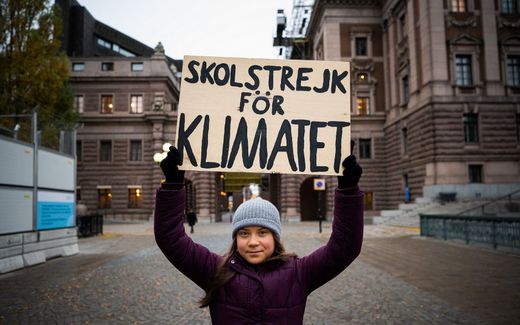
Eventually, she even lived through depression due to the lack of action taken against climate change. Her understanding of the issue led her to take extreme measures, such as beginning a school strike, becoming vegan, and avoiding flying or even shopping.
More recently, her efforts for “climate justice” have spread to other issues, including showing support for Palestine or advocating for LGBT issues. But she still seems unable to answer the question: What is enough?
Play
In addition to changing her own habits, Greta began to work on her parents’ lifestyle at a young age. Her fears soon began to influence their behaviour. She ultimately succeeded in convincing her parents to stop flying and even went so far as to monitor their shopping by checking their receipts.
Such a reversal of roles may seem humorous at first, yet a fair understanding of Sweden, Greta’s country of origin, renders it less surprising. Although her parents explained their own change of habits as a way to help their daughter overcome depression, it seems likely that cultural factors may have also been at play.

Thanks to influences such as John Dewey, the Reggio Emilia approach and Astrid Lindgren, children are treated much like adults in Sweden. They are generally viewed as unspoiled free spirits and as competent individuals. To those who listen, they can even show a new and better way to live.
Pippi Longstocking
It is unsurprising that a girl like Greta could rise to prominence in a society like Sweden, as Swedish children’s culture has a strong anarchist streak to it. This is particularly visible in the work of Swedish children’s author Astrid Lindgren and her stories about Pippi Longstocking.
Pippi Longstocking is a girl without parents. Her mother is deceased, while her father is a sea captain and the king of an unspecified southern island. Meanwhile, Pippi lives cheerfully alone in Sweden, in a dilapidated house, with just a monkey and a horse to keep her company. This is why she always does exactly as she pleases.
At first glance, Pippi may seem attractively unique — wild, self-willed and inspiring. Yet a closer look at the story reveals that she is a budding anarchist. In writing about a character of this kind, Astrid Lindgren is, in fact, encouraging defiance and idealising willful action.
Thus, it is unsurprising to discover similarities between Pippi and Greta. Like Greta, Pippi refuses to attend school. Like Greta, Pippi also resists the police actively, takes matters into her own hands and causes both bewilderment and confusion in social order. Her childish rebellion and incredible girl power create a striking contrast with her two well-raised (albeit rather dull) neighbours, who watch Pippi’s exploits in awe and wonder.
Voice of the future
In a similar way, some have listened to Greta as a prophet. She was the voice of the children. She was the voice of the future. She was the voice of our conscience. Or was she the voice of fear, guilt, anarchy and shame? Words such as “I want you to panic” or “How dare you?” strike a chord with those easily moved. And yet, it would be wise to take a closer look at where such words spring from.
Instead of being a prophet of our times, Greta seems to be a victim of guilt and fear. In fact, her activism is a direct result of teaching the climate narrative at schools. This situation demonstrates that, as can be seen in Greta’s case, children lack the intellectual capacity, experience and wisdom to deal with such complex ideas.
Contrary to the Swedish educational approach, they also lack the mental or emotional capacity to take the lead in the world. This is why their parents and teachers would do well to protect them from climate theories that may provoke excessive emotional distress or feelings of unfounded guilt and responsibility.
Life and death
Guilt, fear and shame are poor motivators, as a tormented monk discovered first-hand 500 years ago. German monk Martin Luther had a completely different issue to deal with than Greta. Yet he, too, believed it to be an issue of life and death.
As he grew in the knowledge of a holy God, Luther became increasingly conscious of his own sins. His life began to revolve around the all-important question: “What is enough to appease God?”
Luther’s torturous ordeal came to an end only when he discovered that God had already granted acceptance through the death of His Son, Jesus.
This life-changing realisation put an end to his striving. Confessions, fasts, pilgrimages and vigils would never be sufficient. Luther’s faulty theology only resulted in impossible demands, hatred towards God and ultimately despair, somewhat reminiscent of Greta Thunberg’s climate guilt.

But thankfully, Luther discovered grace. And it is God’s grace that became the motivating factor behind all his good works. Over the years, he worked tirelessly for the good of his neighbours through preaching, writing, and translating the Bible.
The result? Universal education, growth of literacy, greater freedom of conscience and an improvement in women’s position, to mention but a few. It is noteworthy that grace was the foundation upon which even the Protestant work ethic developed.
This singularly wholehearted approach to one’s work, whether it be painting buildings or nursing patients, naturally contributed to the growth of the economy.
Slave masters
Luther’s societal impact began only when he realised that nothing we do is enough. We are all in dire need of grace. Yet, oddly enough, it is this realisation that spurred improvement in our world.
This transition highlights a key distinction: guilt and fear are relentless slave masters, quenching life-giving creativity and sapping strength. But a grace-based approach to life rests in the knowledge that all will be made well again.

The Europeans of old had faith in God’s restorative work in this world. They knew that they were to work the land and care for it according to God’s instructions. This meant a rhythm of work and rest, for themselves and for creation.
People were not to be guilt-driven in life, but gratefulness-driven instead. They were to work the earth, eat from it and care for it, for their own good and for the good of creation.
And all on the basis of grace — a grace which one hopes activists like Greta may also discover.



Related Articles